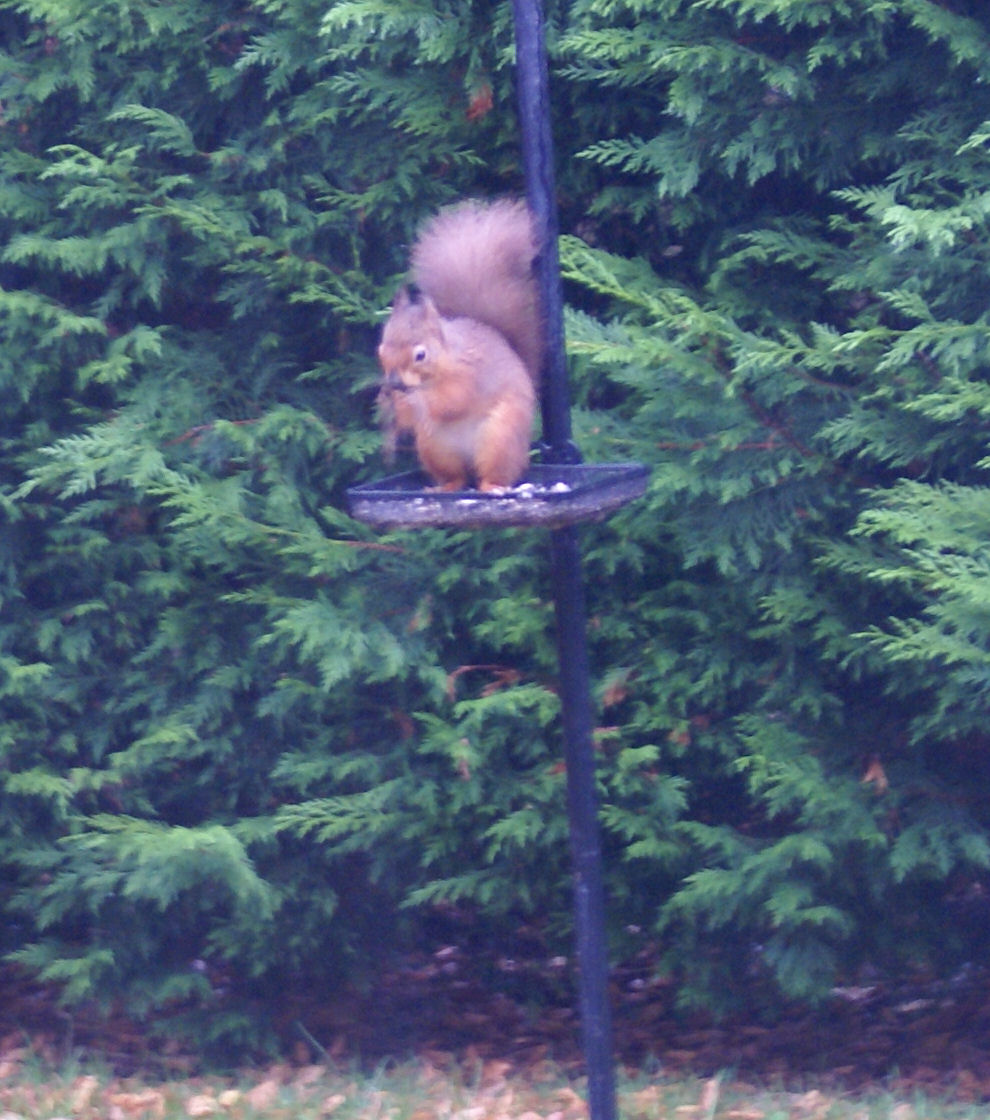
Hi folks, I'm back from a successful, if somewhat damp, bird-watching trip. I'll post a couple of photographs once they are all downloaded. Meanwhile, we had a visitor to our own bird table at home this morning. Apologies for the slight blurring, but I was taking these with the big lens hand-held and I'm not as steady as I once was. You'll note how different the colour seems depending on the magnification and angle of the shot - it is the same animal each time.
I'll be out of communication for a few days, but before I go I'll leave you with one last picture from the top of Brown Carrick Hills - this time looking eastwards. It might not be immediately obvious, but there is a deep wide valley in the near foreground.
Taken from the same spot as yesterday, two forms of transport of quite different speeds.
The aircraft is a Ryanair jet, one of the low-cost airlines which have come to the fore recently. How low-cost is a matter of conjecture since everything 'extra' is an added cost. The latest humorous comment on Ryanair is they are about to charge for "emotional baggage" as well.
Today's photograph was taken from the top of the Brown Carrick hills overlooking Ayr Bay. The centre of the photograph is Wellington Square and the Sheriff Court just beyond the Low Green in Ayr.
Whilst I was looking through my older photographs for yesterday's item, I found others I thought might be of interest. I'll post these on an occasional basis.
This one from 2005 was taken at the North-West of Arran, on the hills just above Locharanza, and includes the departure of the Cal-Mac ferry, the Loch Tarbert, from Lochranza to Clonaig. The view is over the junction of the Kilbrannan Sound and the Sound of Bute, looking up Loch Fyne.
I had thought that an observation hide was meant to 1. hide you from the birds you were observing and 2. hide, at least to some degree, itself from the birds as well.
You'll see from this photograph that it isn't the case here. There are some neatly camouflaged low hides at Caerlaverock, but also a couple of towers like this one.
A larger selection of birds this time. You'll see Canada Geese, Greylag Geese, Mallards (male and female), Wigeons and, of course, Feral Pigeons - including 2 in flight!.
The three swans with the yellow, black-tipped beaks are Whooper Swans and the single swan with the orange beak is a Mute Swan. The goose is a Canada Goose.
Fullarton House, designed in the "Adam" style, was erected by William Fullarton in 1745. Louis Napoleon is said to have stayed there, and Robert Burns, who was an admirer of Colonel Fullarton, possibly visited as a guest.It was purchased by Troon Town Council in 1928, but the house was allowed to fall into a poor state of repair and was demolished in 1966.
All that remains are two pillars, one of which is shown in the photograph.
All right, I know they aren't birds! We had gone down to Troon Harbour to see what birds were about and found there were at least 5 Grey Seals loafing around in the inner harbour. They seemed to be as interested in us as we were in them.
This view of Bogton Loch was taken from approximately the same position as the view of Craigengillan House, but looking downstream towards Dalmellington. Before the dam-building activities up at Loch Doon, the area around Bogton Loch and further down the river was very boggy. Now Bogton Loch is a protected site of special scientific interest and supports significant populations of birds.
The Estate has been in existence since 1611, owned by the McAdam family, original family surname MacGregor, although the house was substantially redesigned in 1765 and has been modified several times since.
Possibly one of the most notable members of the family was John {Tar} McAdam, due to his work on road construction.
Loch Doon (or Balloch Castle) dates from the 13th or 14th centuries and is an eleven-sided curtain-wall construction of beautifully hewn blocks of ashlar.
You may notice that it is in a not particularly defensible position.
This is because the was castle designed to stand on and defend its original island site at the southern end of Loch Doon - thus the peculiar shape which conformed to the shape of the island.
The level of Loch Doon was raised in the 1930's for the Galloway Hydro-electric scheme. Castle Island was submerged but the outer shell of the castle was dismantled and re-erected about 1935 on the shore near Craigmulloch Farm, where it can still be seen today.